Hi
After gratefully using Blogger.com for some time now, I've decided to try setting up my own web page, and hosting my blog there.
The site is at ShaneBaker.photos.
My first blog post on my site is titled Fixing your geodata in Lightroom.
I hope you'll find the blog useful, and visit my site from time to time.
Happy shooting.
Shane
Wednesday, 23 April 2014

Tuesday, 11 March 2014
Shooting in the dark
Recently, I've done some shooting after dark. Two sessions produced work with which I'm reasonably, and one was a disaster. (Well ... kind of!)
And let me say right now - this isn't a tutorial of any kind. We have the wonderful gift of the internet, and I guess that you, like me, hit Google if you have a question on photography.
Anyway ... the first of these nocturnal exercises was photographing fireworks. It came as a surprise to me when I realised that I hadn't photographed fireworks in the digital era. (Strange but true!) So, I trundled down to Lake Burley Griffin here in Canberra on 26 January (Australia Day) to record the show.
The first thing I decided was that I wouldn't go with the crowds. I chose a spot a little further away than average, with relatively few people and with a clear view of the show. This allowed me to use a normal focal length and my 24 - 70mm zoom. Fireworks are by definition, long exposures, so I took a good solid tripod with a reliable ball head.
Apart from those decisions, it was going to be a "suck it and see" exercise. I only had a vague idea of the sort of settings I might use - and I also knew that fireworks photography is manual photography.
So I set the Nikon on manual everything: manual focus, manual exposure mode and switched off auto ISO. Why? Because fireworks will confuse the exposure systems on even the best cameras.
The thing to remember is that fireworks are incredibly bright - and they're pushing out all that light against a dark, even black sky. Your camera simply won't know what's going on, and you're likely to get a very over-exposed image if you let the camera off the leash. Also, no-one knows how long a firework will take to do whatever it does.
So what were my settings? They were:
The show started at 21:00, and I exposed a first frame by guess work. The exposure (using the bulb setting, remember) was 6.7 seconds (which seemed about right), but the highlights were burnt out. I dropped the aperture to f/9.0, and the exposure looked better. A third shot was at f/10 and that was better still.
The ISO and aperture settings were right - but as I was using "bulb", the actual exposure remained a guess! (Shades of
the 19th century!!) Let me provide two examples.
The first was with the shutter open for about 8 seconds. I was happy with that.
The second image didn't work.
In an attempt to get the whole explosion, I kept the shutter open for 10 seconds, without reducing the aperture or ISO - and the result was a terribly over-exposed image.
We live and learn - not the least because fireworks photography is an inexact science!
If you've not tried this form of photography, give it a go.
One thing: don't engage the high ISO compensation setting. It slows the rate at which you can get shots, and especially towards the end, when they have that final all-out display, you won't keep up.
The second session I had was doing some star photography.
A group of us from the Southside Camera Club hired a hut in the Kosciuszko National Park. Apart from the peace, the views and the wildlife, Currango also offered fairly clear skies - so a few of us tried some star photography.
How did we do it?

Well, like fireworks, it's all manual photography. However, unlike fireworks, the stars are very dim. So while my fireworks shots above could be made at f/10 and ISO 200, the milky way image to the right was made in 30 seconds at f/2.8 at ISO 3200. Focus was manual, of course, and file format was again, raw.
Why 30 seconds? Two reasons. Firstly, that's the longest exposure I can dial into the Nikon - which appeals to my lazy side. Secondly, that's the longest exposure I could make with a 15mm focal length without obvious star trails. (Dividing your lens' effective focal length into 500 will indicate the maximum exposure. Hence 500 / 15mm = 33 seconds.)
So, I've described my successes ... now for the "disaster".
I was out in the Melbourne CBD, when I made the image below.
Yuck!

Classic camera shake - because it was exposed at 1/4 second. Maybe, I could have pulled it off had I been leaning against a power pole - maybe - but at that shutter speed, it's really tripod stuff.
The reason the camera was shooting at a quarter of a second? Because I had it set at f/8 in aperture priority. The camera was just following orders.
Why had a made those settings? I haven't a clue! On a crop frame camera, f/2.8 or thereabouts would have been fine - and in any case, depth of field was hardly an issue. I simply messed up.
Had I set the camera on shutter priority at say 1/30 second with auto ISO, I'd have a usable and interesting shot.
But I didn't.
Ah well ... I won't do that again - even if it's simply to avoid embarrassment.
Shane
And let me say right now - this isn't a tutorial of any kind. We have the wonderful gift of the internet, and I guess that you, like me, hit Google if you have a question on photography.
Anyway ... the first of these nocturnal exercises was photographing fireworks. It came as a surprise to me when I realised that I hadn't photographed fireworks in the digital era. (Strange but true!) So, I trundled down to Lake Burley Griffin here in Canberra on 26 January (Australia Day) to record the show.
The first thing I decided was that I wouldn't go with the crowds. I chose a spot a little further away than average, with relatively few people and with a clear view of the show. This allowed me to use a normal focal length and my 24 - 70mm zoom. Fireworks are by definition, long exposures, so I took a good solid tripod with a reliable ball head.
Apart from those decisions, it was going to be a "suck it and see" exercise. I only had a vague idea of the sort of settings I might use - and I also knew that fireworks photography is manual photography.
So I set the Nikon on manual everything: manual focus, manual exposure mode and switched off auto ISO. Why? Because fireworks will confuse the exposure systems on even the best cameras.
The thing to remember is that fireworks are incredibly bright - and they're pushing out all that light against a dark, even black sky. Your camera simply won't know what's going on, and you're likely to get a very over-exposed image if you let the camera off the leash. Also, no-one knows how long a firework will take to do whatever it does.
So what were my settings? They were:
- Aperture: f/8.0
- Shutter: set to bulb - meaning that the shutter is open as long as the shutter is depressed
- ISO: 200
- Manual focus. I focussed on the appropriate spot while it was still light.
- Raw (of course)
- High ISO settings were engaged - more on that in a moment.
The show started at 21:00, and I exposed a first frame by guess work. The exposure (using the bulb setting, remember) was 6.7 seconds (which seemed about right), but the highlights were burnt out. I dropped the aperture to f/9.0, and the exposure looked better. A third shot was at f/10 and that was better still.
The ISO and aperture settings were right - but as I was using "bulb", the actual exposure remained a guess! (Shades of
 |
| 8 second exposure |
The first was with the shutter open for about 8 seconds. I was happy with that.
The second image didn't work.
In an attempt to get the whole explosion, I kept the shutter open for 10 seconds, without reducing the aperture or ISO - and the result was a terribly over-exposed image.
We live and learn - not the least because fireworks photography is an inexact science!
 |
| 10 second exposure - with blown-out highlights |
One thing: don't engage the high ISO compensation setting. It slows the rate at which you can get shots, and especially towards the end, when they have that final all-out display, you won't keep up.
The second session I had was doing some star photography.
A group of us from the Southside Camera Club hired a hut in the Kosciuszko National Park. Apart from the peace, the views and the wildlife, Currango also offered fairly clear skies - so a few of us tried some star photography.
How did we do it?
Well, like fireworks, it's all manual photography. However, unlike fireworks, the stars are very dim. So while my fireworks shots above could be made at f/10 and ISO 200, the milky way image to the right was made in 30 seconds at f/2.8 at ISO 3200. Focus was manual, of course, and file format was again, raw.
Why 30 seconds? Two reasons. Firstly, that's the longest exposure I can dial into the Nikon - which appeals to my lazy side. Secondly, that's the longest exposure I could make with a 15mm focal length without obvious star trails. (Dividing your lens' effective focal length into 500 will indicate the maximum exposure. Hence 500 / 15mm = 33 seconds.)
So, I've described my successes ... now for the "disaster".
I was out in the Melbourne CBD, when I made the image below.
Yuck!
Classic camera shake - because it was exposed at 1/4 second. Maybe, I could have pulled it off had I been leaning against a power pole - maybe - but at that shutter speed, it's really tripod stuff.
The reason the camera was shooting at a quarter of a second? Because I had it set at f/8 in aperture priority. The camera was just following orders.
Why had a made those settings? I haven't a clue! On a crop frame camera, f/2.8 or thereabouts would have been fine - and in any case, depth of field was hardly an issue. I simply messed up.
Had I set the camera on shutter priority at say 1/30 second with auto ISO, I'd have a usable and interesting shot.
But I didn't.
Ah well ... I won't do that again - even if it's simply to avoid embarrassment.
Shane
Saturday, 18 January 2014
A fifth mode on your DSLR?
We're all familiar with the usual four modes on our digital cameras: program, aperture priority, shutter priority and manual. Different manufacturers use slight different terms, but that's what they mean. Of course, some cameras also have "helping" modes like landscape, portrait and so on.
I do most of my shooting in aperture priority. I want to control depth of field, and to a large extent, that involves controlling the aperture. And usually, I'm happy for the Nikon to work out what what shutter speed works.
Recently, I was trying to photograph a baby bird in a tree in my yard. It was tricky because I was using a
long lens (so a highish shutter speed was needed), but I also wanted a reasonable depth of field, since focussing was occasionally tricky. So - I needed a smaller aperture.
This sounded like a job for manual exposure!
But to add to my problems, I was moving around, so as the angle to the sun varied, so did the amount of light hitting the camera. Manual was becoming ... inconvenient.
Then it occurred to me that I had another option: I switched ISO to auto, and let the camera work it out while I stuck with my preferred aperture and shutter speed.
It worked! As the light varied, I still had my preferred aperture (hence depth of field), and camera shake was minimised with a fairly high shutter speed - and the camera changed its sensitivity to ensure it got the right exposure.
So, I reckon we have now five modes on our DSLRs now: program, aperture priority, shutter priority, manual - and "semi-manual".
Try it next time you're in a demanding situation. It just might help.
Shane Baker
Canberra
I do most of my shooting in aperture priority. I want to control depth of field, and to a large extent, that involves controlling the aperture. And usually, I'm happy for the Nikon to work out what what shutter speed works.
 |
| Not a great shot - but sharp and correctly exposed. |
long lens (so a highish shutter speed was needed), but I also wanted a reasonable depth of field, since focussing was occasionally tricky. So - I needed a smaller aperture.
This sounded like a job for manual exposure!
But to add to my problems, I was moving around, so as the angle to the sun varied, so did the amount of light hitting the camera. Manual was becoming ... inconvenient.
Then it occurred to me that I had another option: I switched ISO to auto, and let the camera work it out while I stuck with my preferred aperture and shutter speed.
It worked! As the light varied, I still had my preferred aperture (hence depth of field), and camera shake was minimised with a fairly high shutter speed - and the camera changed its sensitivity to ensure it got the right exposure.
So, I reckon we have now five modes on our DSLRs now: program, aperture priority, shutter priority, manual - and "semi-manual".
Try it next time you're in a demanding situation. It just might help.
Shane Baker
Canberra
Sunday, 5 January 2014
Arranging keywords in Lightroom - a quick tip
If you're like me, your keywords in Lightroom are in a mess.
For instance, I have a "France" keyword. Then, under that, I have some France keywords under "France", while others are at the top level in the hierarchy. Not good - especially if your keywords are in the hundreds or more.
Of course, you can just drag and drop: drag "Amiens" over "France" and LR will move Amiens into the France hierarchy.

But what if you want to drag "Aardvark" under Zoo? That's no so easy if you have more than 40 or so keywords.
I've finally come up with a solution.
Let's say you have the keyword "Black Swan" and you want it under "Native bird".

In the search field under Keyword List, type "swan, native". LR (bless its heart) then lists all keywords containing "swan" and "native" - and no others. You can now simply drag and drop "Black Swan" under "Native bird".
It's not a quick process, but it's do-able!
I'm acutely aware that many/most readers will be quietly muttering something to the effect that everyone knows this. Either that - or why didn't this idiot arrange his keywords correctly in the first place?
Good points - but I'm sure a few people out there have painted themselves into the same corner that I've managed to do. Now I have a solution!
Guess what I'm doing for the next hour?
Have a good one.
Shane
Canberra
PS: As soon as I'd hit publish, I stumbled across an excellent article by Scot Bastion entitled A further look at Keywords within Lightroom.
I think my technique still has its place, but I strongly suggest you read Scot's article before using the Baker Method!
S
For instance, I have a "France" keyword. Then, under that, I have some France keywords under "France", while others are at the top level in the hierarchy. Not good - especially if your keywords are in the hundreds or more.
Of course, you can just drag and drop: drag "Amiens" over "France" and LR will move Amiens into the France hierarchy.
But what if you want to drag "Aardvark" under Zoo? That's no so easy if you have more than 40 or so keywords.
I've finally come up with a solution.
Let's say you have the keyword "Black Swan" and you want it under "Native bird".
In the search field under Keyword List, type "swan, native". LR (bless its heart) then lists all keywords containing "swan" and "native" - and no others. You can now simply drag and drop "Black Swan" under "Native bird".
It's not a quick process, but it's do-able!
I'm acutely aware that many/most readers will be quietly muttering something to the effect that everyone knows this. Either that - or why didn't this idiot arrange his keywords correctly in the first place?
Good points - but I'm sure a few people out there have painted themselves into the same corner that I've managed to do. Now I have a solution!
Guess what I'm doing for the next hour?
Have a good one.
Shane
Canberra
PS: As soon as I'd hit publish, I stumbled across an excellent article by Scot Bastion entitled A further look at Keywords within Lightroom.
I think my technique still has its place, but I strongly suggest you read Scot's article before using the Baker Method!
S
Saturday, 4 January 2014
On the value of photographs (again)
I know I've written about this before (and probably will again), but we must never underestimate the value of our photographs.
Most people do - and I think this is why they don't preserve them.
It's long been my view that any photograph can have value, for any or all of the following reasons:
And I must stress, an image can have one, two or even all three of these attributes.
Yes, he had time and yes he had access - but the images he produced are wonderful.
For instance: the exhibition has images of the men on the construction site balanced precariously on huge assemblies of steel and concrete as they're lifted into place. They're wearing hard hats, shorts and tee shirts - and some at least have safety boots. No doubt, at the time this was normal practice. However these days, I expect (and hope) that there would be a greater focus on safety!

And look what else is in the image: the 1962 Sydney skyline, a ship tied up at the passenger terminal, The Rocks - and the old ferry.
Important stuff - and worth recording!
The other exhibition is Suburban Noir at the Sydney Museum. This is a commentated slide show of forensic photography. Yup - photographs taken by the Police at various scenes covering theft, accidents, murder and suicide. And I was mesmerised!
No, it wasn't the gore (of which there wasn't much, by the way). Neither was it the photographs. They were workmanlike shots, but made for coroners and courts - not for exhibition.
The fascination was the recording of a place that's gone forever: Sydney in the 1940s, 50s and 60s.
It's a place that's as exotic as any third world country today - and unlike Nepal or Amazonia, it's not on any airline's route map. It's gone forever - except in these images - and many others surviving in photo albums around Australia.
So - treat your photographs with respect. They are a repository of people, places, things and events that will one day be gone - except in your preserved images.
Have a happy and productive 2014.
Shane Baker
Most people do - and I think this is why they don't preserve them.
It's long been my view that any photograph can have value, for any or all of the following reasons:
- it's a great photograph - well exposed, composed, etc. Photographs by Ansel Adams or Josef Karsh are classic examples; or
- it's a photograph made in time - of an event or thing that's no-longer there. This could be a news event, or an image of a landscape or cityscape; or
- it's of value to you. Photographs of kids or a beloved relative fit this category.
And I must stress, an image can have one, two or even all three of these attributes.
I recently spent a day in Sydney, and I went to two exhibitions featuring photographs. One was the exhibition of David Moore's photographs of the Sydney Opera House under construction.
Moore was a genuinely great photographer, who was able to turn his hand to pretty much any genre. And his work ticked at least two of those boxes above.
Moore was brilliant at what I would broadly describe as "industrial photography". He could find art in pretty uninspiring opportunities:
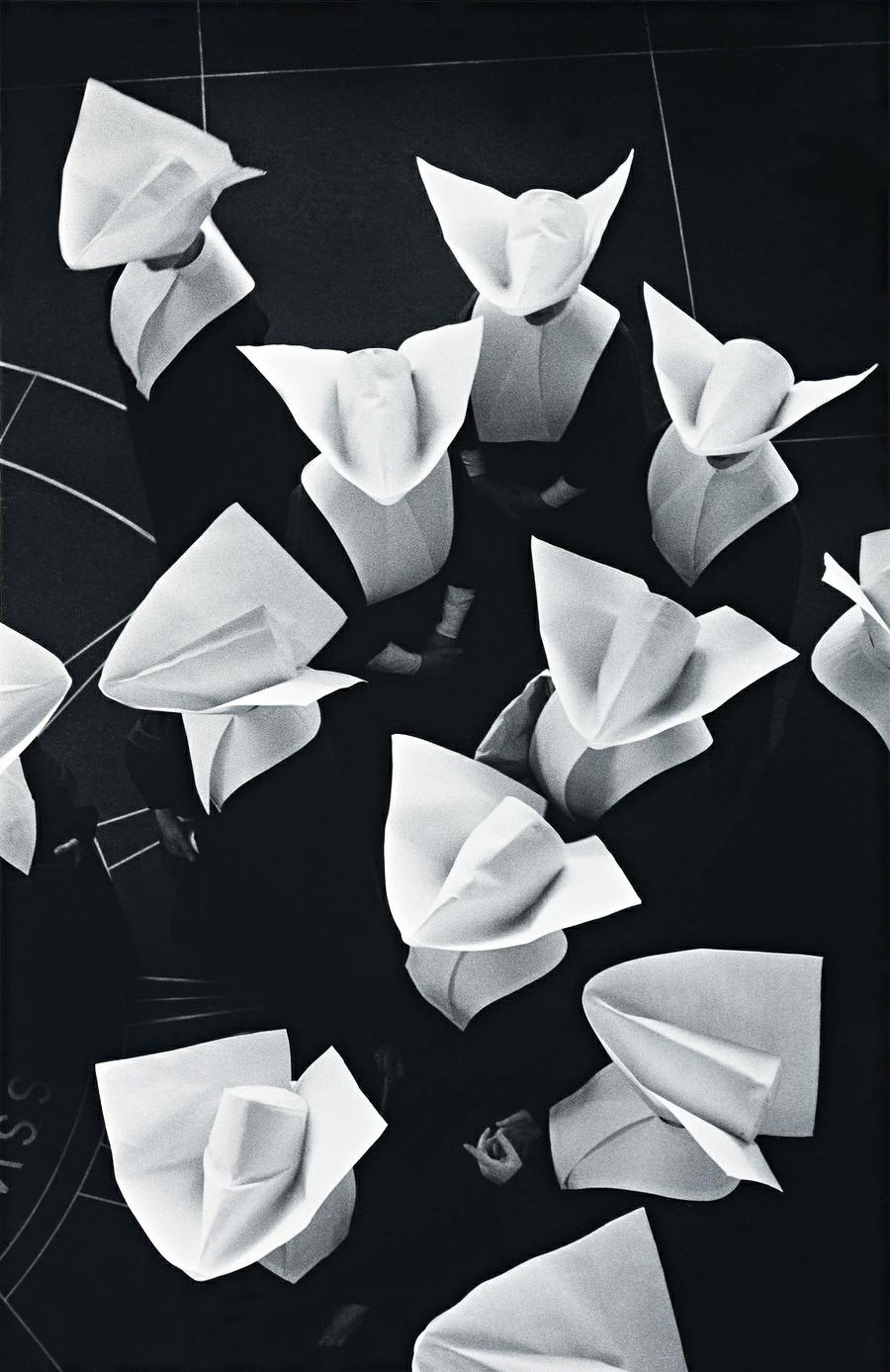 |
| Sisters of Charity Washington |
Moore was brilliant at what I would broadly describe as "industrial photography". He could find art in pretty uninspiring opportunities:
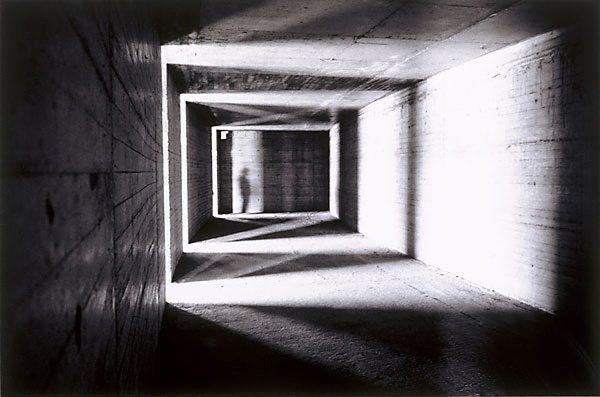 |
| Sydney Opera House under construction 2 |
Yes, he had time and yes he had access - but the images he produced are wonderful.
 |
| Sydney Opera House steel reinforcing – c.1962 |
These photographs are important for a number of reasons including that they are beautiful in their own right, they record the creation of one of the iconic buildings of the world, and because they record a moment in time.
For instance: the exhibition has images of the men on the construction site balanced precariously on huge assemblies of steel and concrete as they're lifted into place. They're wearing hard hats, shorts and tee shirts - and some at least have safety boots. No doubt, at the time this was normal practice. However these days, I expect (and hope) that there would be a greater focus on safety!

And look what else is in the image: the 1962 Sydney skyline, a ship tied up at the passenger terminal, The Rocks - and the old ferry.
Important stuff - and worth recording!
The other exhibition is Suburban Noir at the Sydney Museum. This is a commentated slide show of forensic photography. Yup - photographs taken by the Police at various scenes covering theft, accidents, murder and suicide. And I was mesmerised!
No, it wasn't the gore (of which there wasn't much, by the way). Neither was it the photographs. They were workmanlike shots, but made for coroners and courts - not for exhibition.
The fascination was the recording of a place that's gone forever: Sydney in the 1940s, 50s and 60s.
It's a place that's as exotic as any third world country today - and unlike Nepal or Amazonia, it's not on any airline's route map. It's gone forever - except in these images - and many others surviving in photo albums around Australia.
So - treat your photographs with respect. They are a repository of people, places, things and events that will one day be gone - except in your preserved images.
Have a happy and productive 2014.
Shane Baker
Friday, 20 December 2013
My wife's making some good photographs - and we have proof
In the past, my wife has:
a. listened to me as I banged on about the technology and aesthetics of photography; and
b. taken the line that she just took snaps - leaving the photography to me.
However, in the past few months, she's started using a Fuji X10, and is getting some very good results. She's applying what she knows started to pay attention to her own photography and apply what she knows. She's .
F'rinstance, she got this shot at Whitby Abbey in Yorkshire - which I conspicuously failed to capture:
And I like this one (of me) from our recent trip to Britain.
Nice shots, huh?
Not just snaps, but well-composed photographs!
But it's not just my opinion. A few days back, she experienced that comment that each of us who make photographs, rather than take snaps eventually receive. A colleague commenting on her photography said
... you must have a really good camera!
Yep! Linda's a photographer now!
Season's greetings, everyone.
Shane
a. listened to me as I banged on about the technology and aesthetics of photography; and
b. taken the line that she just took snaps - leaving the photography to me.
However, in the past few months, she's started using a Fuji X10, and is getting some very good results. She's applying what she knows started to pay attention to her own photography and apply what she knows. She's .
F'rinstance, she got this shot at Whitby Abbey in Yorkshire - which I conspicuously failed to capture:
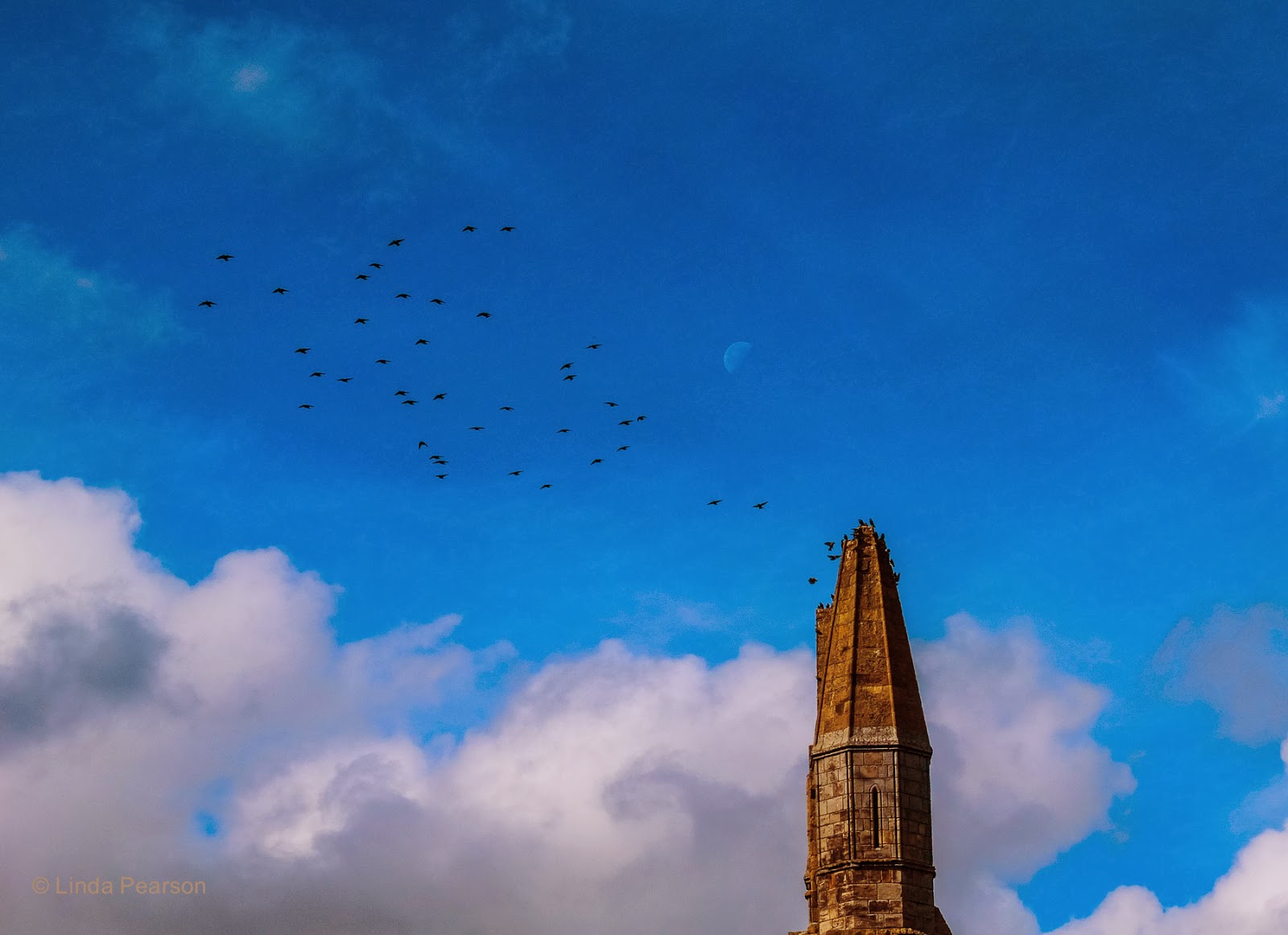 |
| Birds and the moon over Whitby Abbey. |
And I like this one (of me) from our recent trip to Britain.
 |
| Shane at Hampton Court |
Nice shots, huh?
Not just snaps, but well-composed photographs!
But it's not just my opinion. A few days back, she experienced that comment that each of us who make photographs, rather than take snaps eventually receive. A colleague commenting on her photography said
... you must have a really good camera!
Yep! Linda's a photographer now!
Season's greetings, everyone.
Shane
Thursday, 19 December 2013
Rubbish on my drive
I think I started digging around in my Lightroom catalogue because I'd decided to make myself a "best of" photo book. (I did, by the way - and I thoroughly recommend it to any keen photographer. It was such a buzz to see the book.)
Anyway ... I started with star ratings, and then rediscovered that I'd never had a really consistent way of rating my work. In fact, most of my images have no rating whatsoever, meaning I would be thrown back on that least reliable device in my arsenal: my memory.
Argh!
So started trawling through my images - and found in incredible amount of rubbish. Three, four or more copies of the same image in various formats and sizes; most of which is the legacy of my pre-Lightroom days
BLR (before Lightroom), I'd load my raw file onto my computer and open it in Photoshop. Then I'd tweak it a bit and because I wanted my "negative" file for the future, I'd save it as a TIF. TIFs have the advantage that they aren't lossey - but they're big.
I did an experiment, to demonstrate file sizes - based on a file from my 16.3 Meg Fuji X100s:

A 34 Meg raw file becomes a 64 Meg TIF to protect the data after processing - or I could have saved it as a .PSD file to allow for more processing, which would be the same size. Alternately, I can save space with a JPEG or one quality or another - but only by throwing away much of my data. Oddly enough, the smallest non-lossy format was Adobe's DNG format. Maybe there's a lesson in that.
But the point is that I did this for several years: creating TIF and JPEG versions of files - often with a smaller "web" version of the JPEG - and cluttering up my drives, and thoroughly confusing myself in the process.
Then Lightroom appeared - and I saw it was good.
Now, my workflow is to load the image files onto my computer using LR - which places it in my catalogue. I then always (and for once, "always" means always) keyword the images, and can process them.
Processing in this case means making adjustments which are stored by LR with my raw file at a cost of around 10k per file. The raw file remains pristine, and I can make virtual versions of any image, which allows me to have multiple versions of my images - at a cost of about 10k per version.
And because all these files are key worded - as well as having all their metadata - I can find a particular image in moments.
Yes, I'm a fan of LR and no, I don't get a spotter's fee from Adobe. In fact, due to their introducing their ridiculous subscription model for most of their products, Adobe's off my Christmas card list this year - but Lightroom is a great product.
As for my back catalogue, I find that 84% of the 29,500 images in LR have no rating - and most of the rest are rated in an idiosyncratic manner (to say the least!). So, if I rate 100 a day, say six days a week ... that will only take 11 months to complete.
What I really need is a 100% reliable script which will rate my images for me.
Christmas is coming up, so if Father Christmas and the Birthday Fairy work together, maybe I can have my wish.
Or ... I can suck it up and just do it ...
Season's greetings!
Shane
Anyway ... I started with star ratings, and then rediscovered that I'd never had a really consistent way of rating my work. In fact, most of my images have no rating whatsoever, meaning I would be thrown back on that least reliable device in my arsenal: my memory.
Argh!
So started trawling through my images - and found in incredible amount of rubbish. Three, four or more copies of the same image in various formats and sizes; most of which is the legacy of my pre-Lightroom days
BLR (before Lightroom), I'd load my raw file onto my computer and open it in Photoshop. Then I'd tweak it a bit and because I wanted my "negative" file for the future, I'd save it as a TIF. TIFs have the advantage that they aren't lossey - but they're big.
I did an experiment, to demonstrate file sizes - based on a file from my 16.3 Meg Fuji X100s:
A 34 Meg raw file becomes a 64 Meg TIF to protect the data after processing - or I could have saved it as a .PSD file to allow for more processing, which would be the same size. Alternately, I can save space with a JPEG or one quality or another - but only by throwing away much of my data. Oddly enough, the smallest non-lossy format was Adobe's DNG format. Maybe there's a lesson in that.
But the point is that I did this for several years: creating TIF and JPEG versions of files - often with a smaller "web" version of the JPEG - and cluttering up my drives, and thoroughly confusing myself in the process.
Then Lightroom appeared - and I saw it was good.
Now, my workflow is to load the image files onto my computer using LR - which places it in my catalogue. I then always (and for once, "always" means always) keyword the images, and can process them.
Processing in this case means making adjustments which are stored by LR with my raw file at a cost of around 10k per file. The raw file remains pristine, and I can make virtual versions of any image, which allows me to have multiple versions of my images - at a cost of about 10k per version.
And because all these files are key worded - as well as having all their metadata - I can find a particular image in moments.
Yes, I'm a fan of LR and no, I don't get a spotter's fee from Adobe. In fact, due to their introducing their ridiculous subscription model for most of their products, Adobe's off my Christmas card list this year - but Lightroom is a great product.
As for my back catalogue, I find that 84% of the 29,500 images in LR have no rating - and most of the rest are rated in an idiosyncratic manner (to say the least!). So, if I rate 100 a day, say six days a week ... that will only take 11 months to complete.
What I really need is a 100% reliable script which will rate my images for me.
Christmas is coming up, so if Father Christmas and the Birthday Fairy work together, maybe I can have my wish.
Or ... I can suck it up and just do it ...
Season's greetings!
Shane
Wednesday, 11 December 2013
Oil on my sensor - my D800 sensor
Let me tell you a tale ...
I went out for a quick shoot earlier in the week. (You will not see any of these images as they were sharp, perfectly exposed, incredibly boring images. (But I digress.)
When I loaded them into Lightroom, I saw this stuff in the sky:

Weird, huh?
It had to be dust, so I tried blowing it away with my trusty rocket blower and did a test exposure (an f/20 shot of a blue sky). Nope, still there!
So I went to my Plan B: using a specialised electrostatically-charged brush which in the past, removed all but the most stuck-on muck. The streaks were made worse!
So I had to resort to Plan C: wet cleaning using some preprepared sensor swabs that I just happened to have ordered a few days previously. They just seemed to move the mess around.
I was stumped. It wasn't behaving like any dust, or any fibres I'd seen before (which in retrospect should have been a clue!) - so I fired up Google.
After quite a bit of trawling, I found a (very) few posts about oil on D800 sensors! Argh!! We've all heard about the problems with oil on the D600, but on an 800? This is a pro camera!!
The problem was that oil, wherever it had come from, made sense. The "smears" could have been a fluid. It also explained why the blower did nothing, a swipe with a swab didn't do much, and the brush made it worse. However, it didn't explain why a high-end, made in Japan Nikon had oil on its sensor.
So, I began by visiting my local pharmacy and asking them for a high purity solvent. They sold me a tiny bottle of 99% pure isopropyl alcohol, which I was tempted to use on the sensor, but which I only used the wash my electrostatic brush.
After the brush dried, I used another swab on the sensor. The sensor looked better, but not great. So I used the brush - which actually improved the situation! The isopropyl alcohol had done the trick and the brush wasn't moving oil around.
With a few bits still on the sensor, I used the blower - and the sensor is now almost perfect. Good enough at least that hopefully, the camera's cleaning mode will shake off the last bits. If not, I can handle it in post.
I'm not thrilled - but at least I can use my camera.
It will be interesting to see what Nikon says about this.
Shane
in Canberra
I went out for a quick shoot earlier in the week. (You will not see any of these images as they were sharp, perfectly exposed, incredibly boring images. (But I digress.)
When I loaded them into Lightroom, I saw this stuff in the sky:
Weird, huh?
It had to be dust, so I tried blowing it away with my trusty rocket blower and did a test exposure (an f/20 shot of a blue sky). Nope, still there!
So I went to my Plan B: using a specialised electrostatically-charged brush which in the past, removed all but the most stuck-on muck. The streaks were made worse!
So I had to resort to Plan C: wet cleaning using some preprepared sensor swabs that I just happened to have ordered a few days previously. They just seemed to move the mess around.
I was stumped. It wasn't behaving like any dust, or any fibres I'd seen before (which in retrospect should have been a clue!) - so I fired up Google.
After quite a bit of trawling, I found a (very) few posts about oil on D800 sensors! Argh!! We've all heard about the problems with oil on the D600, but on an 800? This is a pro camera!!
The problem was that oil, wherever it had come from, made sense. The "smears" could have been a fluid. It also explained why the blower did nothing, a swipe with a swab didn't do much, and the brush made it worse. However, it didn't explain why a high-end, made in Japan Nikon had oil on its sensor.
So, I began by visiting my local pharmacy and asking them for a high purity solvent. They sold me a tiny bottle of 99% pure isopropyl alcohol, which I was tempted to use on the sensor, but which I only used the wash my electrostatic brush.
After the brush dried, I used another swab on the sensor. The sensor looked better, but not great. So I used the brush - which actually improved the situation! The isopropyl alcohol had done the trick and the brush wasn't moving oil around.
With a few bits still on the sensor, I used the blower - and the sensor is now almost perfect. Good enough at least that hopefully, the camera's cleaning mode will shake off the last bits. If not, I can handle it in post.
I'm not thrilled - but at least I can use my camera.
It will be interesting to see what Nikon says about this.
Shane
in Canberra
Saturday, 7 December 2013
On using the Nikon D800
It's been a while, hasn't it? This was supposed to be a fortnightly (or thereabouts) blog, but I've never achieved anything like that.
I have no excuses - so to the kind or bored souls who read my ramblings: my apologies.
Nearly a year ago, I bought a Nikon D800. It's a superb camera, but it does have its drawbacks. Firstly, in a world hankering for small and light, it's neither.
This doesn't mean that it can't be used for street photography, though!
But I digress.
Also, due to its staggering 36 M sensor, it's a camera which doesn't tolerate errors. Unless my focus is pin sharp, images from it are almost useless.
This creates problems. Due to it being full frame, the depth of field compared with my old and much-beloved crop frame D300 is very shallow. This means I need small apertures / high f-numbers for anything that isn't stationary - which can be a problem as, unless I'm using a tripod, I need a high enough shutter speed to avoid camera shake.
Of course, sometimes a tripod isn't an option. This is the result of a 30 second exposure:
I've got to say that I'm in awe of modern digital cameras. Look at the contrast ratio in that shot and the colour balance. Somehow, the D800 has handled at least five different light sources and still produced a great image.
The red streak is the tail lights of a passing car. It also left a "ghost" of its roof near under the street light on the right!
Anyway - the bottom line is that every photographer needs a tripod - and a good tripod at that. I'd suggest that you go for a ball head. Just make sure it can handle the weight of any camera-lens combination you're likely to use in the future.
The other result of going full frame is the loss of focal length. Using a crop frame sensor means that the focal length of every lens is effectively changed. On a Nikon APS-C camera such as the D300, my 70-200 is effectively a 105 - 300, which is handy when trying to photograph birds. (It's not so good when going wide. My 14 - 24 was a 21 - 36 on the D300.)
Anyway ... I decided to get myself a teleconverter to try to get some "reach". I bought the Nikon x1.7 unit, which as you would expect, increases the focal length of a lens by a factor of 1.7, at a cost of losing 1.5 f-stops.
So far, I'm happy with the results. This little chap was up in a small tree and using my 70 - 200 would
have meant either a tiny image, or the need for me to crop very hard indeed. Using my lens effectively as a 340mm telephoto, got what is for me, an effective image.
The loss of speed due to the teleconverter isn't an issue, as I have to stop the lens down to achieve a good depth of field.
I actually worked "semi-manually" with this. I had the camera on auto ISO and manual. I selected the appropriate aperture, went for a high, 1/500 sec shutter speed and dialled in centre-weighted metering. The Nikon did the rest.
I'm no bird photographer - so I'm happy with the result.
Keep making those photographs!
Shane Baker
Canberra
I have no excuses - so to the kind or bored souls who read my ramblings: my apologies.
Nearly a year ago, I bought a Nikon D800. It's a superb camera, but it does have its drawbacks. Firstly, in a world hankering for small and light, it's neither.
This doesn't mean that it can't be used for street photography, though!
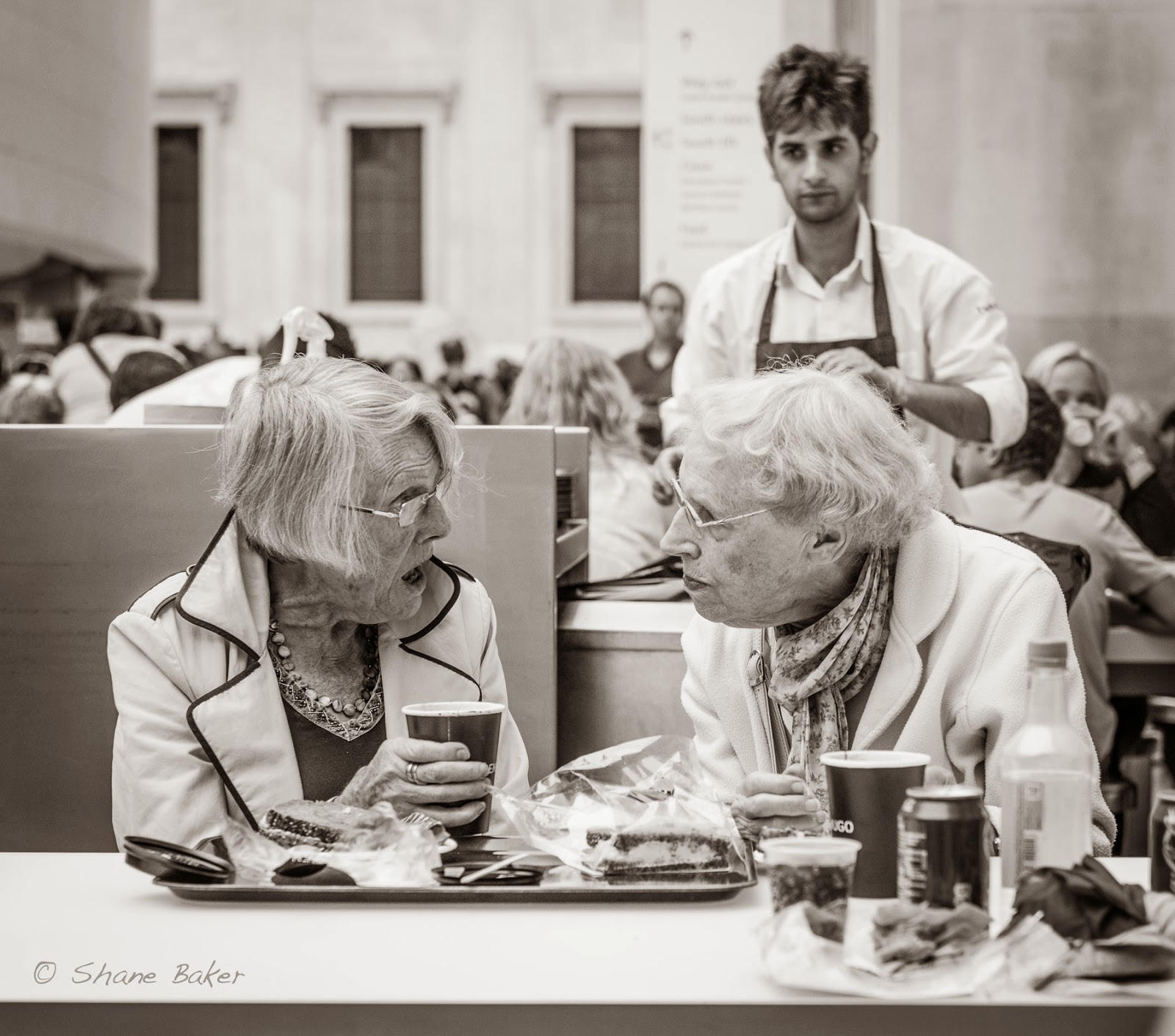 |
| At the British Museum |
But I digress.
Also, due to its staggering 36 M sensor, it's a camera which doesn't tolerate errors. Unless my focus is pin sharp, images from it are almost useless.
This creates problems. Due to it being full frame, the depth of field compared with my old and much-beloved crop frame D300 is very shallow. This means I need small apertures / high f-numbers for anything that isn't stationary - which can be a problem as, unless I'm using a tripod, I need a high enough shutter speed to avoid camera shake.
Of course, sometimes a tripod isn't an option. This is the result of a 30 second exposure:
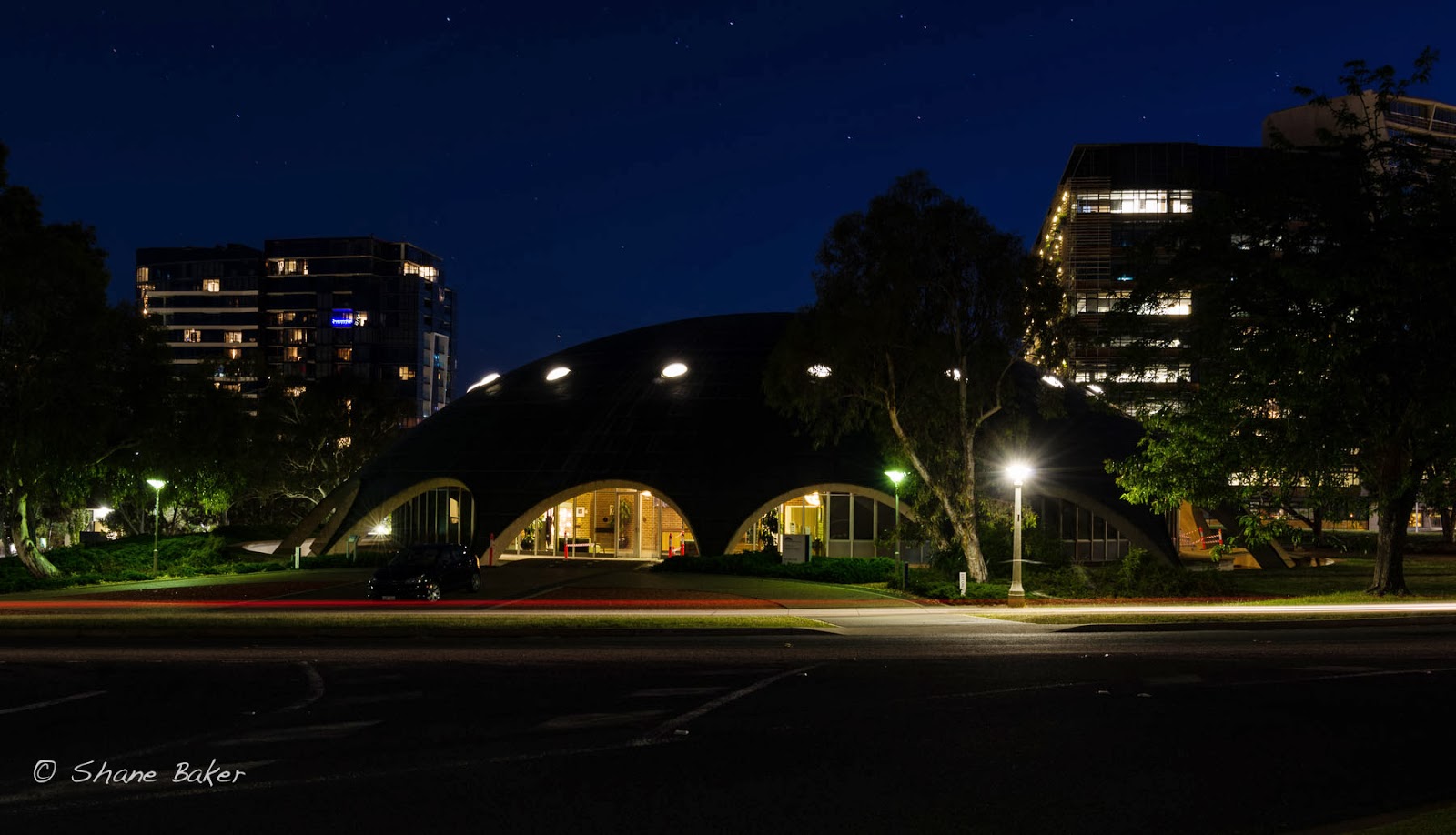 |
| Shine Dome, Canberra |
I've got to say that I'm in awe of modern digital cameras. Look at the contrast ratio in that shot and the colour balance. Somehow, the D800 has handled at least five different light sources and still produced a great image.
The red streak is the tail lights of a passing car. It also left a "ghost" of its roof near under the street light on the right!
Anyway - the bottom line is that every photographer needs a tripod - and a good tripod at that. I'd suggest that you go for a ball head. Just make sure it can handle the weight of any camera-lens combination you're likely to use in the future.
The other result of going full frame is the loss of focal length. Using a crop frame sensor means that the focal length of every lens is effectively changed. On a Nikon APS-C camera such as the D300, my 70-200 is effectively a 105 - 300, which is handy when trying to photograph birds. (It's not so good when going wide. My 14 - 24 was a 21 - 36 on the D300.)
Anyway ... I decided to get myself a teleconverter to try to get some "reach". I bought the Nikon x1.7 unit, which as you would expect, increases the focal length of a lens by a factor of 1.7, at a cost of losing 1.5 f-stops.
So far, I'm happy with the results. This little chap was up in a small tree and using my 70 - 200 would
 |
| Baby magpie lark |
The loss of speed due to the teleconverter isn't an issue, as I have to stop the lens down to achieve a good depth of field.
I actually worked "semi-manually" with this. I had the camera on auto ISO and manual. I selected the appropriate aperture, went for a high, 1/500 sec shutter speed and dialled in centre-weighted metering. The Nikon did the rest.
I'm no bird photographer - so I'm happy with the result.
Keep making those photographs!
Shane Baker
Canberra
Thursday, 7 November 2013
Hopes in the retro camera trend
There's been endless fuss this week (and in fact, for several weeks) about Nikon's new full frame SLR, the Df and its retro look.

The good news about the Df (in my opinion) includes:


The good news about the Df (in my opinion) includes:
- sensor and processor apparently from the top of the line Nikon D4.
- major controls accessible through good old-fashioned knobs, which are not only easy to use, but which show at a glance where they're set. Great!
- it's smaller and lighter than many new SLRs, despite having a proper, metal body.
- it can conveniently use old Nikkor lenses.
The bad news isn't great. In Australia at least, the Df will sell for more than the 36 meg, pro body D800. And this is for a camera with fewer autofocus points than the D800, one card slot, no built-in flash and no video capability.
Ouch!
Of course, as with all things, the proof of the camera will be in the actual images produced in real situations. For this, we must wait.
Joe McNally has posted some nice shots already - but Joe could produce great images with a box Brownie. He's no indication of how a photographer of modest (even very modest) attainment such as myself will go armed with a Df.

Time will tell - as it will also tell regarding whether this "retro" look with mechanical dials is a marketing gimmick, or a trend. Fujifilm seems to have started this with their X series cameras and they've justifiably received high praise for these cameras. Pick one an X100s for example, and you'll note metal analogue dials controlling aperture, shutter speed and exposure compensation - in a metal body. They even take an old-fashioned cable release!
I hope it's a trend. I love my D800, as I did my D300 that preceded it. Great cameras - reliable, ergonomic tools which produce great images. It's just that I'd like to be able to see what's what by glancing at a dial - as we could in the stone age.
Maybe Nikon and Fuji have realised that the film cameras they made for all those years had something going for them in the digital age: analogue controls.
Let's hope so.
Shane Baker
Friday, 11 October 2013
Gear for travelling
My wife and I recently returned from a five week trip to Britain and France. Naturally, I saw this as a photo op as well as a holiday, and took cameras with me. Eight or nine kgs of cameras.
In 2011, we did a similar trip, where I took my Nikon D300 (a crop frame SLR) with my 24-70 f/2.8 and my then-new 14-24 f/2.8. I was surprised to discover that 90% of my images were made with the 14-24 on that trip - but bearing in mind that with the crop frame APS-C sensor, the lens is a 21-36mm equivalent lens, in retrospect that's not so surprising.
On this trip, I took my monster D800 with those two lenses, plus a few odds and sods, including a light meter, a 50mm f/1.8 and ND and polarising filters.
I also took my new Fujifilm X100s - and seriously considered taking this alone. A friend of mine who is a mirrorless convert pushed me in that direction, and photographer Valérie Jardin had recently demonstrated it was possible to take the Fuji alone on a four week holiday. In the end, I compromised by also taking the Fuji - which is tiny by SLR standards. I also undertook to "do" Paris with the Fuji only.
So - how did it go?

Well, with the greatest respect, unless you are like Ms Jardin, a street photographer, I can't see the X100s as a replacement for an SLR. It's a brilliant camera, but the fixed focal length lens places some limitations.
Take the shot of Notre Dame to the right. A pleasant enough shot, and the camera handled to demanding light well, but the fixed 35mm equivalent lens means that I didn't get the whole edifice.
"Zoom with your feet", I hear you cry, and in many cases, that's valid. However - in places like Paris, which are awash with @#$%^*! tourists (why can't they leave people like you and mean alone?) getting back will mean including endless people - many wearing distracting colours.
The Nikon, with its wider lens would have been better in that case.
 On the other hand, the Fuji came into its own capturing this candid shot in the Louvre.
Could I have got it with the D800? Probably - but I think this young woman might have noticed the big, black, intimidating camera and possibly been distracted by having it pointed at her. (The man in the image below was - and he wasn't even the subject of the shot.)
Clearly, it's horses for courses. The beauty of the Fuji is that weighs almost nothing and takes little space. It's easy to carry in your bag, or even a (capacious) jacket pocket - and it looks like your grandad's old film rangefinder, so no-one cares.
What about the D800?
Well, I'm glad I took it, but it's not a snapshot camera. With its 36 megapixel sensor, it's a demanding, unforgiving camera, and you blaze away with it at your peril.
On the other hand, it can produce luscious colours and detail. The images below, shot in early light in Yorkshire have a detail and depth of colour for which the D800 and its SLR kin were made.
What about lenses? Well, with the full frame D800, the 24mm setting on the 24-70 was wide enough for almost all occasions, and I only used the 14-24 once. It probably could have stayed at home.
And the other gear could have stayed as well. I didn't have time to use the filters - although the polarising filter would have been useful once or twice. I also used the light meter only once - again due to time pressures.

At times, I could have used a tripod. The weather wasn't great for much of the trip, and the need to use small apertures on the full frame D800 for necessary depth of field created problems. It's an occupational hazard. This wasn't an issue on the X100s, of course.
So, was the D800 worth it? Did I need my Kata bag (described by one friend as a "lifeboat")?
I think I did.
I could have taken the X100s only and come away with great results - if I were willing to accept the limitations of that package. The camera is more than capable of producing brilliant images in a wide range of conditions. If, like Valérie, my main interest were street photography, I would have been mad to lump along 2.5kgs of SLR - or my lifeboat.
If, on the other hand, like me, you wished to make a range of images from a wide range of subjects, the SLR remains the best option - unless you go the mirrorless, interchangeable lens route.
Maybe, I'll go that way in the future - but not yet.
Shane Baker
In 2011, we did a similar trip, where I took my Nikon D300 (a crop frame SLR) with my 24-70 f/2.8 and my then-new 14-24 f/2.8. I was surprised to discover that 90% of my images were made with the 14-24 on that trip - but bearing in mind that with the crop frame APS-C sensor, the lens is a 21-36mm equivalent lens, in retrospect that's not so surprising.
 |
| Bruge |
I also took my new Fujifilm X100s - and seriously considered taking this alone. A friend of mine who is a mirrorless convert pushed me in that direction, and photographer Valérie Jardin had recently demonstrated it was possible to take the Fuji alone on a four week holiday. In the end, I compromised by also taking the Fuji - which is tiny by SLR standards. I also undertook to "do" Paris with the Fuji only.
So - how did it go?
Well, with the greatest respect, unless you are like Ms Jardin, a street photographer, I can't see the X100s as a replacement for an SLR. It's a brilliant camera, but the fixed focal length lens places some limitations.
Take the shot of Notre Dame to the right. A pleasant enough shot, and the camera handled to demanding light well, but the fixed 35mm equivalent lens means that I didn't get the whole edifice.
"Zoom with your feet", I hear you cry, and in many cases, that's valid. However - in places like Paris, which are awash with @#$%^*! tourists (why can't they leave people like you and mean alone?) getting back will mean including endless people - many wearing distracting colours.
The Nikon, with its wider lens would have been better in that case.
Could I have got it with the D800? Probably - but I think this young woman might have noticed the big, black, intimidating camera and possibly been distracted by having it pointed at her. (The man in the image below was - and he wasn't even the subject of the shot.)
Clearly, it's horses for courses. The beauty of the Fuji is that weighs almost nothing and takes little space. It's easy to carry in your bag, or even a (capacious) jacket pocket - and it looks like your grandad's old film rangefinder, so no-one cares.
What about the D800?
Well, I'm glad I took it, but it's not a snapshot camera. With its 36 megapixel sensor, it's a demanding, unforgiving camera, and you blaze away with it at your peril.
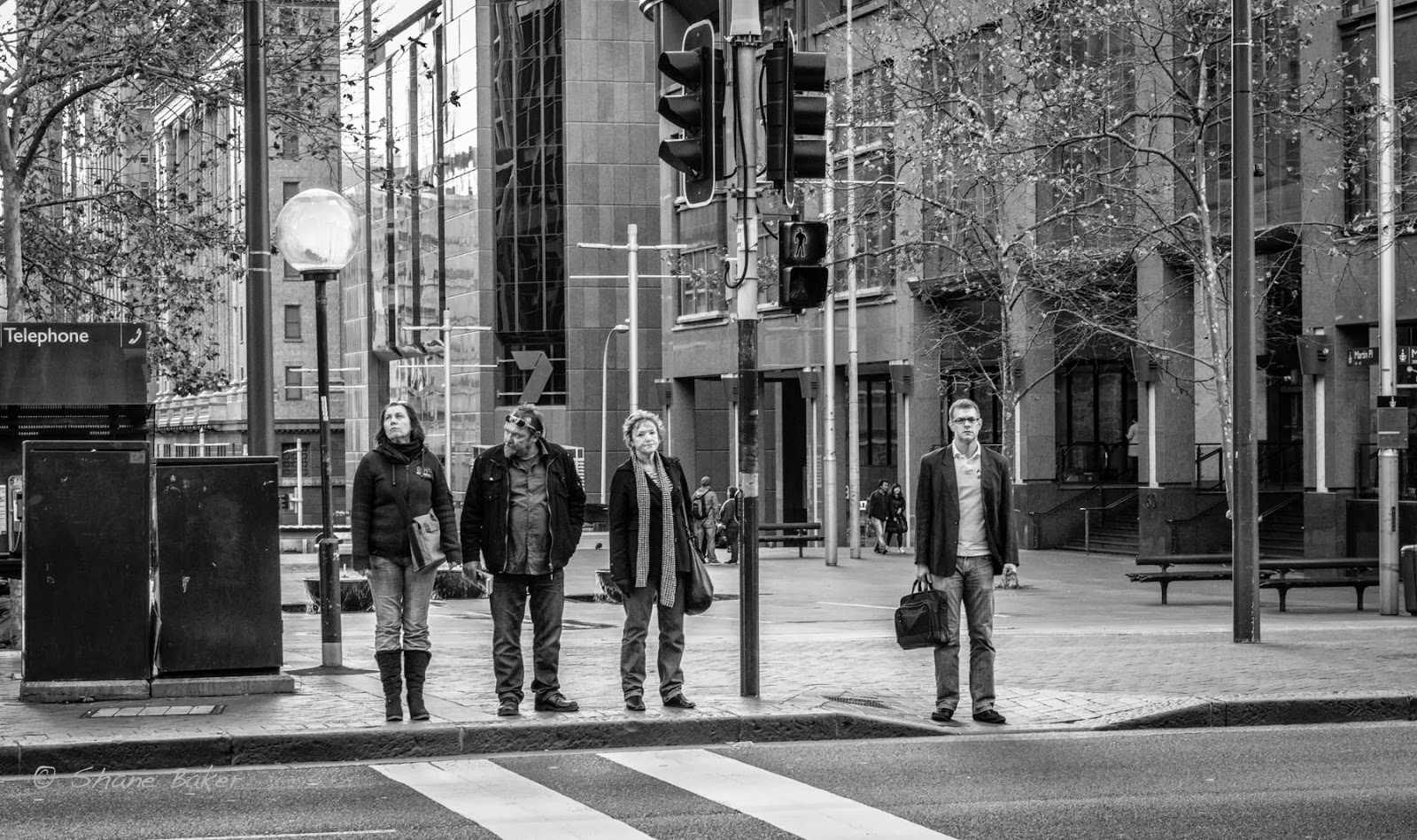 |
| The man on the right has noticed my D800! |
What about lenses? Well, with the full frame D800, the 24mm setting on the 24-70 was wide enough for almost all occasions, and I only used the 14-24 once. It probably could have stayed at home.
And the other gear could have stayed as well. I didn't have time to use the filters - although the polarising filter would have been useful once or twice. I also used the light meter only once - again due to time pressures.
At times, I could have used a tripod. The weather wasn't great for much of the trip, and the need to use small apertures on the full frame D800 for necessary depth of field created problems. It's an occupational hazard. This wasn't an issue on the X100s, of course.
So, was the D800 worth it? Did I need my Kata bag (described by one friend as a "lifeboat")?
I think I did.
I could have taken the X100s only and come away with great results - if I were willing to accept the limitations of that package. The camera is more than capable of producing brilliant images in a wide range of conditions. If, like Valérie, my main interest were street photography, I would have been mad to lump along 2.5kgs of SLR - or my lifeboat.
If, on the other hand, like me, you wished to make a range of images from a wide range of subjects, the SLR remains the best option - unless you go the mirrorless, interchangeable lens route.
Maybe, I'll go that way in the future - but not yet.
Shane Baker
Saturday, 7 September 2013
I was at the British museum yesterday ...
and I noted some strange behaviour from the people there.
There were the usual types with their smart phones and point and shoots, using flash on everything. This was not only distracting for the rest of us, but they were also using flash while shooting through glass.
No doubt, they will get home and curse their cameras for producing fuzzy, wildly over-exposed images - not realising that they would get better results (and longer battery life) with the flash OFF. The green setting is NOT our friend.
Unfortunately like the poor, or politicians, the flash brigade is always out in force, but there was another group: people photographing everything - and I mean that quite literally.
I watched one man with a moderately good point and shoot. He saw nothing there except the back of his camera. He would stand in front of an exhibit for as long as it took to pull focus, shoot, then do the same to the next object. He wasn't experiencing the Museum - he was making a visual collection to look at later.
Now I'd be the last person to object to photography. I'm the one carting my D800 and two heavy lenses in my Kata backpack, and I like to photograph things. But photography isn't a substitute for experience - it's a means to help preserve our memories.
While I was there, I made three photographs. Others were making hundreds.
I'll bet I had the better experience.
Good (and appropriate) shooting.
Shane
Wednesday, 31 July 2013
It's worth looking back on your images
Last Saturday, I went out for a dawn shoot with my friend Rod Burgess.
We weren't quite sure where we were going, but were looking for a spot with the rolling hills typical of parts of the ACT - bathed with dawn's golden light.
We stopped at a spot, and got out our gear.
 |
| Canberra sunrise - looking towards the Murrumbidgee River. |
I recently heard a photographer describe landscape as being like sports shooting - and it's certainly true that at dawn and dusk, the light changes so fast that one can't relax for a moment. The light's changing, meaning that exposure changes and so do opportunities. You've gotta keep ducking and weaving!!
I'd chosen not to use any filters was was relying on the D800's raw files and Lightroom to get the details I wanted.
I was also deliberately "exposing to the right". (I remain to be convinced on the advantages of that strategy - but that's another issue.)
During the shoot, looking at the 3" display on my Nikon, the shots had looked pretty ordinary.
Anyway, I got home and loaded the images into Lightroom - and was pleasantly surprised.
There were a few that made me feel it had been worth getting out of bed at 05:45 on a Saturday morning when there was frost on the ground! The shot here is a case in point. Nice range of colours, textures. Yeah, I was happy with that.
I put this and several other shots up on Smugmug, and relaxed.
Later that day, after tic tacking with Rod, I went back into Lightroom - and was surprised to find this:
 |
| Canberra sky at sunrise. |
Mind you, this process of revision works both ways. I had this on my Smugmug site for quite a while:

No, I don't know what I was thinking, either!

And this was posted for two or three days. Yes, it's a photograph of a platypus - but it doesn't make it worthy of inflicting on visitors to my web site.
I take slight comfort from the fact that some very well known, and very good photographers post duds too. I guess the advantage of the web is that when such a blunder is realised, we can make it go away.
So ... the lesson is to look again at your shots, hours or days later. You'll probably have more pleasant surprises than nasty shocks.
Keep shooting.
Shane
Sunday, 16 June 2013
In praise of the nifty 50
Yesterday morning, I went out with a group of friends from the Southside Camera Club here in Canberra for a "Murrumbidgee River Ramble".
I came away with some acceptable images - and more importantly, neither my camera nor me fell in the drink! (If you miss the significance of this statement, please read my past couple of blogs.)
Anyway, after some landscapes, we repaired to the home of the Club members who had arranged the photo walk, where they provided us with a scrumptious breakfast. (Yes, life can be tough in a camera club!)
Not only did they go above and beyond in the catering department, but they allowed those of us who were interested to use their home studio gear for a little impromptu portraiture and still life work. I wandered in to see Len, the generous and patient husband of one of our members, being photographed.
Well, I couldn't let this pass - but as my semi-aquatic 24-70 is in transit from Nikon, I plonked my "nifty 50" (Nikkor 50mm f/1.8 lens) on my D800 and had a try.
I'm delighted with my results.
The images are sharp, have true colour and good contrast - and were made with a Nikkor AF 50mm f/1.8D, a lens that sells in Australia for $A127. Even its up-market brother, the AF-S NIKKOR 50mm f/1.8G sells for $A250 - which is a fraction of the price of my admittedly wonderful 24-70 f/2.8.
The message is clear. As much as I like three or four of my landscapes from yesterday, I love a couple of the portraits of the long-siffering Len. I hope he does too.
Clearly, I have to get off my backside and do more portraiture. And I've got to use my cheap, light and unobtrusive little nifty 50 more often, as well.
If you haven't got a 50, think about getting one. They're a steal!
Shane
I came away with some acceptable images - and more importantly, neither my camera nor me fell in the drink! (If you miss the significance of this statement, please read my past couple of blogs.)
 |
| Eucalypts at sunrise, Canberra. |
Not only did they go above and beyond in the catering department, but they allowed those of us who were interested to use their home studio gear for a little impromptu portraiture and still life work. I wandered in to see Len, the generous and patient husband of one of our members, being photographed.
Well, I couldn't let this pass - but as my semi-aquatic 24-70 is in transit from Nikon, I plonked my "nifty 50" (Nikkor 50mm f/1.8 lens) on my D800 and had a try.
I'm delighted with my results.
 |
| Len |
 |
| Len |
The message is clear. As much as I like three or four of my landscapes from yesterday, I love a couple of the portraits of the long-siffering Len. I hope he does too.
Clearly, I have to get off my backside and do more portraiture. And I've got to use my cheap, light and unobtrusive little nifty 50 more often, as well.
If you haven't got a 50, think about getting one. They're a steal!
Shane
Saturday, 8 June 2013
To buy a point and shoot - or not?
Olympus is pulling out of low end point and shoot cameras - and I can see why. We don't need them.
One of my wok colleagues asked what camera she should buy in the $100 - $200 range. My reaction? Don't.
Why?
She has a good quality mobile phone - which means she has a good basic camera already. Apart from a zoom lens, I can't see what a $150 compact would offer that her "camera" doesn't already offer.
What I suggested she do is spend her lazy $100 - 200 on software. She's not running a Mac at home so she doesn't have iPhoto - meaning she needs something like PhotoShop Elements or Lightroom to:
Then - keyword your images. Right away! Then and there. Before you do anything else. Pronto.
Seriously, it will take maybe 5 minutes to do a heap of images and once done, they're done forever - and they can be found!
After that, you can do your "post":
Shane
One of my wok colleagues asked what camera she should buy in the $100 - $200 range. My reaction? Don't.
Why?
She has a good quality mobile phone - which means she has a good basic camera already. Apart from a zoom lens, I can't see what a $150 compact would offer that her "camera" doesn't already offer.
What I suggested she do is spend her lazy $100 - 200 on software. She's not running a Mac at home so she doesn't have iPhoto - meaning she needs something like PhotoShop Elements or Lightroom to:
- do "post" on here images - crop, contrast and maybe some colour correction, and
- more importantly ... catalogue her images.
People are generating images all over the place, and then what? They sit on the device until it fails or they're deleted. If they're downloaded to the computer, they sit there without keywords or meaningful names until the disc fails.
Either way, they're not accessible. And if you can't find the image, it's just a waste of disc space.
My advice to anyone without suitable software is to get either Elements or when it's released: Lightroom 5 or start using your copy of iPhoto. Then, catalogue your existing images - which is, I will admit, a horrible job.
However! Once that's done, your work flow could be something like mine: First, download the images from the camera, using just a basic preset - to add a little contrast - or whatever your camera needs.
Seriously, it will take maybe 5 minutes to do a heap of images and once done, they're done forever - and they can be found!
After that, you can do your "post":
- Crop and straighten
- Remove stuff that shouldn't be there - rubbish, idiots, that kind of thing.
- Do any more tweaking of brightness, colour balance, contrast - that kind of thing.
It amazes me how few people look after their images. Almost everyone over 12 has a camera these days and they use them to capture images. Then, for most people, it stops there. At least in the film days, the film would be printed at the local lab. Now? Who knows?
Photographs augment and even preserve our images. They are precious and deserve to be looked after.
Here endeth the lesson.
Have a good one.
Sunday, 2 June 2013
A week after I dropped my D800
And a week after I dropped my D800 - with disasterous results, the reason is starting to show.

When I fell, I obviously made first contact with my left elbow - which was the arm holding the camera!
It could have been worse - but I keep thinking about and missing my knackered Nikon.
My wife tells me that I'm a bit dangerous with a camera, because I tend to become focussed (no pun intended) on the shot and oblivious to my surroundings. She's probably right.
Mind you, I'm not exactly alone in that respect. Look at the horrific casualty rates among war photographers.
And my friend Claude was telling me about stopping in the middle of a street on his recent trip to Vancouver when he saw a shot. He's standing there surrounded by traffic and shooting with his new Fuji X-E1, when he suddenly realises what he's doing.
Still, we've all done stuff like that. It's part of the magic of photography, I guess - and we usually survive!
Saturday, 1 June 2013
To to follow-up on my sad tale of the aquatic D800 ...
Nikon Australia gave me an answer within 72 hours - which I think is good service. The good news is that they can fix the 24-70, albeit at a price. I'll have that back in about a week.
The bad news is that my beloved D800 was already showing signs of corrosion. It wasn't economic to fix.
Sob ...
Back to the trusty D300 for the time being.
So the lesson learned from this - at a price - is that when you carry camera gear in a situation where it could get damaged, put it in your bag.
And by the way, the people I work with have pointed out (rather forcefully I might add) that things could have been worse. I was alone, out of sight and had a heavy fall onto rocks in a river. I could have been injured - or even drowned. I certainly have the bruises to prove that point, although they're nothing that won't heal.
All true, of course - but my D800 is no more!
Sob ...
Sunday, 26 May 2013
A tale of disaster
So I went out to "do some photography" yesterday morning.
The reason? I hadn't made a photograph in weeks and I was feeling withdrawal. And it was foggy and I thought there might be something in it. I got some shots at the National Arboretum here in Canberra - and a couple weren't bad, either.
Anyway, I was heading home, and I thought it might be worth making a diversion to the Murrumbidgee River to see if there was anything to shoot. The sun was up and something might be there, right?
There was. A nice flat surface on a pool in the river with reflections. I just had to get down there.
So, I picked up the Nikon and the tripod and my camera bag and headed down towards some rocks. Slippery rocks.
Next thing I know, it's like someone has kicked my legs out from under me. I hit the rocks like a safe, get back on my feet - and can't see the Nikon. Some frantic looking around and I see it - my D800 with 24 - 70 lens attached literally submerged in the river!
The lens was full of water, so I let it drain and headed home. Once home, I separated the body and lens and placed them into a home-made dehumidifier - where they remain until I can send them to Nikon Service in Sydney tomorrow!
I feel sick just thinking about this beautiful gear submerged in a river. God knows what the service bill will be.
The take away from this? If you've got a bag or a case or whatever, use it if there's the slightest chance of something going wrong - like walking on rocks in a river.
The tale of the repairs waits for another day.
Sigh ...
Shane
The reason? I hadn't made a photograph in weeks and I was feeling withdrawal. And it was foggy and I thought there might be something in it. I got some shots at the National Arboretum here in Canberra - and a couple weren't bad, either.
 |
| Trees in fog, National Arboretum Canberra. © Shane Baker |
Anyway, I was heading home, and I thought it might be worth making a diversion to the Murrumbidgee River to see if there was anything to shoot. The sun was up and something might be there, right?
There was. A nice flat surface on a pool in the river with reflections. I just had to get down there.
So, I picked up the Nikon and the tripod and my camera bag and headed down towards some rocks. Slippery rocks.
Next thing I know, it's like someone has kicked my legs out from under me. I hit the rocks like a safe, get back on my feet - and can't see the Nikon. Some frantic looking around and I see it - my D800 with 24 - 70 lens attached literally submerged in the river!
The lens was full of water, so I let it drain and headed home. Once home, I separated the body and lens and placed them into a home-made dehumidifier - where they remain until I can send them to Nikon Service in Sydney tomorrow!
I feel sick just thinking about this beautiful gear submerged in a river. God knows what the service bill will be.
The take away from this? If you've got a bag or a case or whatever, use it if there's the slightest chance of something going wrong - like walking on rocks in a river.
The tale of the repairs waits for another day.
Sigh ...
Shane
Thursday, 25 April 2013
Kids and photography.
We've had three of the grandkids visiting from Perth this week. Me being me, I offered each of them the use of a camera. The 13 year old has the D300, the 7 year old the D90 and the 5 year old the Fuji X10.
I have to say that despite the patronising comments coming from more than a few adults, they've produced some very good images.
I love digital for kids - or anyone learning photography. The marginal cost of any image is almost nothing, and they get immediate feedback when they try something new. Perfect!
And, of cause, I can give them a set of images on a USB stick that they can print or show to family and friends.
So the message is: don't underestimate kids. Give them a useable camera and they'll deliver.
Friday, 12 April 2013
A portraiture master class with Greg Weight.
Last Sunday, I did a portraiture master class with Greg Weight.
I enjoyed the session, and especially Greg's practical, unaffected view of photography and portraiture. (The fact that he is a Nikon shooter didn't hurt either (Joke!!).
When she picked me up, my wife Linda asked me what I'd learned.
Good question.
I'd certainly learned stuff - but more importantly, I'd gained a few things. Firstly, I realised I knew stuff. I recognised the photographers Greg talked about and often, the images to which he referred. I also understood a fair amount of the technical stuff too.
That means thatI gained confidence in my ability.
But I also came to the conclusion that I don't have to be an expert on portraiture to shoot portraits.
What I did learn / decide / conclude is that I've got to get off my arse and join in. To be an effective portrait photographer ... I've got to shoot portraits.
Yep - I'm nothing if not quick! <blush>
I've lined up friends who have agreed to be photographed, I have the photo kit and I've ordered a backdrop - which I'll use some of the time.
Time to stop talking and start doing - or as Frederick Van Johnson says: Time to take off that lens cap and shoot!
Subscribe to:
Posts (Atom)